Capability Brown: The Man Who Shaped the English Landscape
Capability Brown: The Man Who Shaped the English Landscape
Introduction: The Architect of the English Imagination
When we gaze upon the British countryside, we are often deceived by its apparent naturalness. We see rolling hills, serpentine lakes that disappear into the distance, and carefully placed clumps of trees that seem to have stood there since time immemorial. However, the English landscape, as it exists in the collective imagination, is not a product of nature alone. It is, to a remarkable degree, a constructed artifact - a deliberate manipulation of earth, water, and vegetation designed to evoke specific emotional responses.
While these pastoral scenes appear timeless and untouched, they are often the result of one of the most extensive and radical artistic movements in European history. At the absolute vanguard of this movement stood Lancelot “Capability” Brown. He was a figure whose influence on the physical appearance of England is comparable to the influence of Shakespeare on the English language. He did not merely garden; he sculpted the horizon.
Born in the rugged, agrarian landscape of Northumberland in 1716, Brown rose from the relative obscurity of a yeoman farmer’s son to become the Royal Gardener and the most sought-after designer of his age. His career spanned the middle decades of the eighteenth century, a period of profound social, economic, and aesthetic transformation. This was the era of the Enlightenment, of the agricultural revolution, and of a burgeoning national confidence that sought to define British identity against the cultural dominance of the continent.
Brown’s work was the visual manifestation of this new identity. He rejected the rigid, authoritarian geometries of the French formal garden - the style of Versailles and absolute monarchy - in favor of a “natural” style that celebrated freedom, informality, and the inherent beauty of the land itself. However, to view Brown merely as a reaction against French formality is to simplify his genius. His vision was not born in a vacuum, nor was it solely a product of the intellectual salons of the south. It was deeply rooted in the soil of the North. The expansive horizons, the muscular topography, and the dynamic river valleys of Northumberland provided the raw aesthetic material that Brown would later refine into the masterpieces of Blenheim, Chatsworth, and Stowe. Furthermore, the industrial vitality of the North East, with its mining technologies and hydraulic engineering, equipped Brown with the technical skills necessary to reshape the hydrology of estates across the kingdom.
Part I: The Record – Lancelot Brown, Baptized 1716
The Register of St. Wilfrid’s and the Yeoman Context
The story of the man who would reshape England begins in a humble setting. The primary documentary anchor for the life of Lancelot Brown is found in the parish registers of St. Wilfrid’s Church in Kirkharle, a small hamlet situated in the Wansbeck valley of Northumberland. The entry, dated August 30, 1716, records the baptism of Lancelot Brown, the fifth of six children born to William and Ursula Brown. While the precise date of his birth remains unrecorded - a common lacuna in early eighteenth-century records - the baptismal entry establishes his entrance into the community that would form his character.
The significance of this record extends far beyond mere chronology. It situates Brown within a specific and vital stratum of rural society: the yeomanry. His father, William Brown, was a yeoman farmer and land agent for the local squire, Sir William Loraine. In the rigid hierarchy of rural England, the yeoman occupied a pivotal middle ground. They were not of the gentry, yet they were distinct from the laboring poor. They possessed a degree of independence and, crucially, a professional intimacy with the land that the aristocracy often lacked.
As a land agent, William Brown would have been responsible for the practical administration of the estate. His duties included the surveying of fields, the management of tenants, the drainage of bogs, and the maximization of agricultural yields. This meant that young Lancelot was exposed from birth to the pragmatic realities of land management.
On the other side of his parentage, Lancelot’s mother, Ursula (née Hall), had worked in service at Kirkharle Hall, the “big house” of the estate. This connection to the Hall is vital for understanding Brown’s social fluidity. It meant that the young Lancelot grew up straddling two worlds: the muddy reality of the working farm and the refined atmosphere of the manor house. This dual exposure is evident in his later career, where he displayed a remarkable ability to communicate with both the laborers who moved the earth and the Dukes who paid for it. He possessed the practical vocabulary of the soil and the aesthetic vocabulary of the salon.
The church itself, St. Wilfrid’s, offers further insight into Brown’s early visual conditioning. A simple fourteenth-century structure, it stands as a testament to the deep historical roots of the Northumbrian borderlands. Scholars have suggested that the experience of looking through the church windows during long services may have influenced Brown’s later obsession with “framing” views - creating compositions in the landscape that operated like paintings seen through a fixed aperture.
The Kirkharle Estate: An Incubator of Improvement
To understand the intellectual environment of Brown’s youth, one must look to the activities of the Loraine family. Kirkharle in the early eighteenth century was not a sleepy backwater; it was a site of intense agricultural and landscape “improvement.” The estate had been in the hands of the Loraine family since the fourteenth century, but it was Sir William Loraine, the 2nd Baronet (1658–1743), who transformed it.
Sir William was a man of the Enlightenment - a barrister, a Member of Parliament, and a dedicated improver. Between 1694 and 1738, he embarked on a massive program of planting and enclosure that fundamentally altered the character of the estate. Archives indicate the staggering scale of these operations: he planted over 24,000 forest trees and nearly 488,000 quicksets (hawthorn saplings used for hedging).
The planting of nearly half a million quicksets represents roughly 48 kilometers of new hedgerow. This was landscape engineering on a grand scale. Brown did not grow up in a static, “natural” landscape; he grew up in a landscape that was being actively manufactured. He saw that the earth could be drained, that fields could be enclosed, and that trees could be marshaled to serve human ends.
His father’s role as land agent meant that Lancelot likely accompanied him on inspections of these works. He would have learned the techniques of planting, the necessity of protecting young saplings from livestock, and the principles of drainage - skills that would form the technical bedrock of his later career. The Loraine estate was, in effect, his apprenticeship. Before he ever read a treatise on aesthetics, he understood the economics and mechanics of land management.
Education at Cambo: Mathematics and the Mind
The myth of the “unlettered genius” - a rustic savant who intuitively understood nature - is dispelled by the record of Brown’s education. He attended the village school in nearby Cambo, walking the two miles from Kirkharle daily. He remained in education until the age of sixteen, a significantly longer period than was typical for a boy of his social standing in the 1730s.
The curriculum at Cambo would have provided Brown with a solid grounding in the “three Rs,” but most crucially, in arithmetic and mathematics. In the eighteenth century, land surveying was a mathematical discipline involving geometry and trigonometry. Brown’s later ability to calculate the volumes of earth required to build a dam, or the gradient necessary to create a “serpentine” river that flowed but did not stagnate, relied entirely on this early mathematical training.
The walk to school itself was an education. The route took him through the Wallington estate, owned by the Blackett family. Unlike the enclosed, improved fields of Kirkharle, the wider Northumbrian landscape offered broad vistas, rolling hills, and a sense of scale that would become a hallmark of the “Brownian” style. The daily traversal of this terrain - experiencing the rise and fall of the land, the changing light on the Cheviot Hills, and the flow of the Wansbeck river - instilled in him a deep, visceral understanding of topography. He absorbed the “grammar” of the Northumbrian landscape: the way a slope meets a valley, the way a river bends around a spur of land, the way a clump of trees on a horizon draws the eye.
Part II: The Vision – From French Formal to English Natural
The Tyranny of the Straight Line: The Jardin à la Française
To appreciate the revolutionary nature of Brown’s vision, one must look to the aesthetic regime he sought to dismantle. In the early eighteenth century, high-status gardening in Europe was dominated by the jardin à la française, a style epitomized by the work of André Le Nôtre at Versailles. This style was an architectural extension of the house, characterized by geometric rigidity, bilateral symmetry, and a philosophy of domination over nature. Trees were clipped into unnatural shapes (topiary), water was forced into geometric pools and fountains, and the garden was strictly separated from the chaotic “wilderness” beyond by high walls.
In England, this style had been adopted by designers like London and Wise, but by the 1730s, it was increasingly viewed with political suspicion. The Whig aristocracy, who formed the bulk of Brown’s later clientele, began to associate the rigid geometry of the French garden with the tyranny of absolute monarchy and Catholic authoritarianism. There was a growing appetite for a style that reflected British “liberty” - a landscape that appeared free, unconstrained, and constitutional.
The Brown Revolution: The “Natural” Style
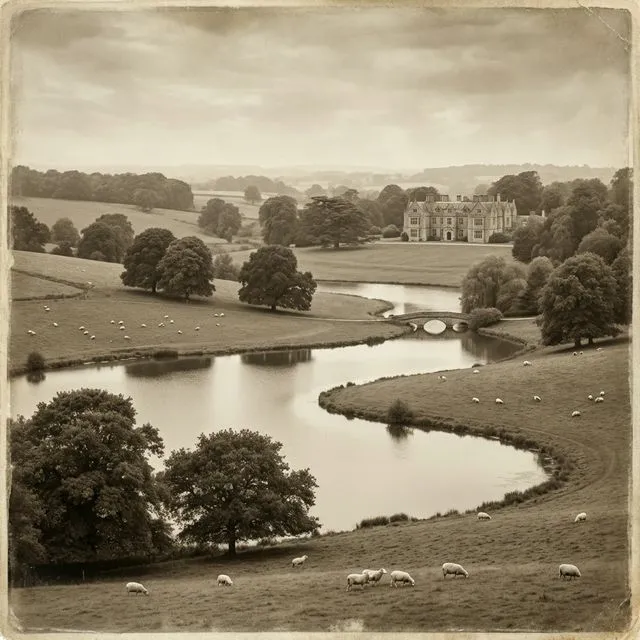
Lancelot Brown codified and popularized the “English Landscape Garden” to such an extent that it became the national idiom. His vision was radical in its minimalism. He swept away the parterres, the terraces, the topiary, and the straight avenues. In their place, he introduced a vocabulary of forms derived from an idealized version of nature.
Central to his design was the Serpentine Line. Drawing on William Hogarth’s “Line of Beauty,” Brown rejected the straight line in favor of the curve. He argued that nature abhors a straight line. Consequently, his lakes curved to hide their ends (creating an illusion of infinite length), his paths wound through the trees, and his driveways approached the house at oblique angles to reveal shifting perspectives.
He also championed the Sweeping Lawn. Brown removed the formal gardens that separated the mansion from the park. He brought the turf right up to the windows of the house, creating a seamless integration between the domestic and the pastoral. This was a democratization of the view; the house was no longer a fortress isolated from its land, but a habitation sitting comfortably within it.
To structure the landscape, Brown used trees architecturally. He planted “belts” of trees around the perimeter of the estate to screen the outside world and provide a backdrop. Within the park, he placed “clumps” of trees - often beech or oak - at strategic points to frame views, create depth, and highlight the topography.
Perhaps the most crucial technical innovation was the Ha-Ha. This was a sunken ditch with a retaining wall on the inner side. It acted as a barrier to livestock, keeping sheep and cattle out of the pleasure grounds, but from the house, it was invisible. This allowed for an uninterrupted visual continuity between the manicured lawn and the grazing land beyond, creating the illusion of a boundless estate.
Part III: The Nickname – Why “Capability”?
The Etymology of Optimism
Lancelot Brown is almost never referred to without his famous sobriquet: “Capability.” The persistence of this nickname over three centuries is a testament to its descriptive power. Its origin lies in Brown’s professional conduct and his unique salesmanship.
When Brown arrived at a prospective client’s estate, he would conduct a survey of the grounds, often riding on horseback. Upon completing his inspection, his habitual opening remark to the landowner was that the place had “great capabilities” for improvement. This phrase was not merely a verbal tic; it was a psychological masterstroke.
By speaking of “capabilities,” Brown was complimenting the landowner. He was suggesting that their estate possessed latent beauty and value that was simply waiting to be revealed. He did not say the estate was “ugly” or “old-fashioned”; he said it was capable. The word implied potential. It shifted the focus from the current state of the land (often boggy, agricultural, or formally rigid) to a future state of perfection. Furthermore, by identifying capabilities that the owner could not see, Brown established himself as the visionary expert. Only he possessed the “second sight” necessary to unlock the land’s potential.
The Economics of Capability
The nickname also reflected the economic reality of the eighteenth-century landscape. The “improvements” Brown proposed were immensely expensive. They involved moving thousands of tons of earth, planting vast woodlands, and constructing large bodies of water. A single commission could cost the equivalent of millions of pounds in modern currency.
To persuade aristocracy to part with such sums required more than just artistic flair; it required confidence. The nickname “Capability” branded Brown as a man of action, a man who could deliver. It distinguished him from the “theoretical” architects or the mere nurserymen. In a marketplace crowded with designers, Brown was the man who saw the capability of the land to be transformed into a paradise. This branding was spectacularly successful. Brown became the wealthiest and most famous gardener in English history, earning around £6,000 a year at his peak (approx. £900,000 today).
Part IV: Northern Roots – The Landscape that Made the Man
The Topography of Northumberland: The “Hog-Back” Curve
While Brown’s career flourished in the Midlands and the South of England, the template for his landscapes was forged in the North. Northumberland is distinct from the geography of the Home Counties. It is not a land of sharp peaks or flat fens, but of muscular, rolling hills - often described as “hog-back” hills - and broad, sweeping valleys cut by energetic rivers like the Wansbeck and the Aln.
Scholars argue that Brown’s “undulating line” - the signature curve of his lawns and tree lines - was an unconscious (or perhaps conscious) replication of the Northumbrian horizon. When Brown smoothed the rough ground of a southern estate, he was essentially sculpting it to resemble the weathered, rounded contours of the Cheviots. The “comfort and elegance” he sought to create were the qualities of a productive Northumbrian valley: shelter from the wind, access to water, and a visual rhythm of rise and fall.
Hydraulic Engineering and the Mining Connection
One of the most critical, yet frequently overlooked, aspects of Brown’s Northern heritage is the influence of the region’s industrial base. In the early eighteenth century, the North East of England was the Silicon Valley of its day - a hub of technological innovation centered on coal mining. The primary challenge of mining was water: draining the deep pits required sophisticated hydraulic engineering.
Growing up in Kirkharle, Brown would have been exposed to the machinery of water management: the Newcomen atmospheric engines (introduced in the region in the 1710s), the elaborate systems of sluices, weirs, and drainage channels (adits) used to manage groundwater. It is highly probable that Brown’s knowledge of hydraulics - the physics of water flow, pressure, and containment - was gleaned from observing these industrial systems.
This technical expertise was the secret weapon in his arsenal. When he moved south, he applied the principles of mine drainage to the creation of pleasure lakes. The creation of the Great Lake at Blenheim Palace is perhaps his engineering masterpiece. He took the “trickling river Glyme” and, by building a massive earth dam, flooded the valley to create a lake of immense scale. This required a precise understanding of hydrological loads and dam construction - skills more common to a Northumbrian mine engineer than a southern gardener.
He also utilized the technique of “puddling” - lining the bed of a lake with worked clay to make it watertight. This was a technique standard in canal building and mining, brought by Brown to the ornamental garden. Thus, the “serpentine rivers” that define the English Garden are, in reality, triumphs of industrial engineering.
Alnwick Castle: The Northern Masterpiece
Brown’s return to Northumberland to work on Alnwick Castle (1750–1786) allowed him to apply his mature skills to the most dramatic landscape of his youth. The castle, the seat of the Duke of Northumberland, sits on a ridge overlooking the River Aln.
Brown’s intervention at Alnwick was characterized by a desire to “civilize” the rugged border landscape without destroying its grandeur. The River Aln was originally a shallow, boulder-strewn stream. Brown, working with the canal engineer James Brindley (another connection to industrial engineering), reworked the riverbed. They cleared the boulders, levelled the banks, and installed cascades (weirs) to back up the water. This transformed the turbulent stream into a broad, reflective “river-lake” that mirrored the castle walls - a classic Brownian device of calming the landscape.
Brown also understood the theatricality of approach. He re-routed the roads and remodelled the topography to hide the castle from view as the visitor approached. He built up hills along the roadside so that the castle would be concealed until the final moment, when it would “burst into view at its most impressive angle.” This manipulation of the viewer’s experience demonstrates his mastery of landscape narrative. By smoothing the foreground parkland and planting clumps of trees, Brown created a deliberate contrast with the wild moorland in the distance. This interplay between the “Beautiful” (the park) and the “Sublime” (the moors) is the essence of his Northern work.
Kirkharle: The Lost Plan and the Return of the Native
The most poignant illustration of Brown’s vision is found in his relationship with his birthplace, Kirkharle. As a boy, Brown had worked on the estate under Sir William Loraine, maintaining the formal gardens with their “fountains and fish ponds.” However, late in his career - around 1770 - Brown returned to Kirkharle, not as a servant, but as the master of his profession.
During this period, he drew up a plan for the “improvement” of Kirkharle. This plan, which was lost for over two centuries until its discovery in 1980 by the landowners John and Kitty Anderson, reveals Brown’s desire to erase the formal landscape of his youth. The plan depicts a classic Brownian landscape: a large serpentine lake flowing through the valley, surrounded by informal planting and undulating ground.
The discovery of this plan is significant for two reasons. First, it confirms that Brown applied his aesthetic principles universally, even to the landscape of his own sentimental attachment. He did not seek to preserve the “old ways” of Kirkharle; he sought to improve them. Second, it demonstrates the consistency of his vision. The 1770 plan for Kirkharle is aesthetically consistent with his work at Blenheim or Petworth, showing that his “Northumbrian” style was not just a regional adaptation but a coherent artistic philosophy.
The plan remained unexecuted in Brown’s lifetime. However, in a remarkable post-script to history, the Anderson family began implementing the plan in 2010. Today, the serpentine lake at Kirkharle exists as Brown envisioned it - a posthumous realization of the vision he conceived for his home.
Conclusion: The Legacy of the “Northern Lad”
Lancelot “Capability” Brown died in 1783, having reshaped the face of England more profoundly than perhaps any other individual. He found a country of enclosed, geometric gardens and left behind a landscape of sweeping green parks, serpentine lakes, and noble trees. His style became so ubiquitous that it was eventually seen not as “design” but as “nature” itself.
However, as this report has demonstrated, Brown’s genius was not a rootless phenomenon. It was grounded in the specific geography and society of his Northumbrian upbringing. The record of his baptism at Kirkharle anchors him in the yeoman class - practical, independent, and intimately connected to the land. The vision of the “natural” landscape was a reaction against continental tyranny, but it was also a celebration of the open, rolling topography of the North. The nickname “Capability” reflected the optimism of an age of improvement, an ethos he absorbed from the agricultural innovations of the Loraine estate. And finally, the Northern roots provided the technical toolkit - the mathematics of land surveying and the hydraulics of mining - that allowed him to execute his vision on a monumental scale.
When we look at the great landscapes of Blenheim, Chatsworth, or the newly restored lake at Kirkharle, we are seeing the world through the eyes of Lancelot Brown. But we are also seeing a reflection of the Northumberland of his youth - a landscape of broad horizons, energetic waters, and limitless capabilities. The boy who walked the hills to Cambo school grew up to teach a nation how to see its own beauty.
References & Further Reading
- Capability Brown: The Story of a Master Gardener
- Lancelot ‘Capability’ Brown: The Omnipotent Magician
- The English Landscape Garden
- Engineering the Landscape: Capability Brown’s Role
- Northumberland Landscape Character Assessment