The Rocket: A Locomotive Legend
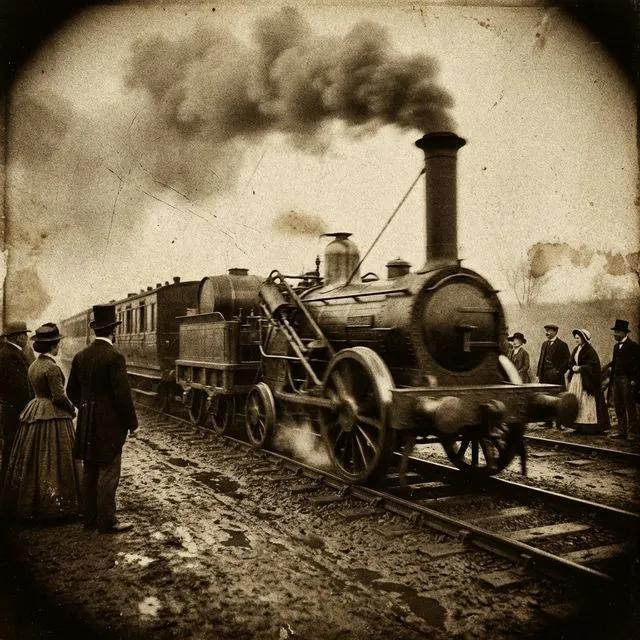
Introduction: The Synthesis of a Revolution
The year 1829 stands as a demarcation line in the history of human technology. Before this date, the concept of rapid, long-distance travel was biologically limited to the endurance of a horse. After this date, humanity entered the age of the machine. At the center of this transformation was a yellow and black machine known as the Rocket.
However, to view the Rocket merely as a singular invention is to misunderstand its nature. As historical analysis reveals, the creation of this locomotive was an act of brilliant integration. George Stephenson and his son Robert did not conjure the machine from the void; rather, they synthesized years of disparate, often clumsy experimentation into a single, cohesive archetype. By the late 1820s, the engineering world was at a stalemate. Distinguished figures such as James Walker and John Rastrick viewed the steam locomotive as a fundamentally flawed technology - clumsy, slow, and fit only for hauling coal at a snail’s pace on colliery tramways. They argued that it lacked the sustained power required for inter-city transport.
The Rocket was the answer to this pessimism. It was the machine that proved the viability of the steam railway, not just as a replacement for the canal barge, but as a mechanism for the “annihilation of space and time.” To understand how this was achieved, we must look inside the machine itself.
Anatomy of the Rocket: A Thermal Breakthrough
The primary obstacle facing early locomotive engineers was the boiler. Preceding engines, such as the Blücher (1814) or Locomotion No. 1 (1825), utilized simple single-flue or return-flue boilers. These designs suffered from a fatal flaw: the ratio of water volume to heating surface area was poor. The fire simply could not touch enough metal to boil the water fast enough. Consequently, these engines were sluggish; after a brief burst of energy, they would often have to stop and wait for steam pressure to regenerate.
The Multi-Tubular Solution
The breakthrough that defined the Rocket - and indeed, defined the steam locomotive for the next century and a half - was the multi-tubular boiler. Interestingly, this idea was not originally Stephenson’s. It is credited to Henry Booth, the Treasurer of the Liverpool and Manchester Railway (L&MR). Booth proposed a radical departure from tradition: instead of one large flue, the hot gases from the firebox should pass through many small tubes submerged in the water.
Robert Stephenson, though initially skeptical about the manufacturing difficulties, realized the potential. The resulting boiler barrel was 6 feet long and 3 feet 4 inches in diameter, packed with 25 copper tubes, each 3 inches in diameter. The mathematics of this design were undeniable. By splitting the gas flow, the design exponentially increased the surface area available for heat transfer.
The manufacturing challenges were immense. The tubes had to be watertight against a pressure of 50 psi, a significant demand for the metallurgy of the era. The differential thermal expansion between the copper tubes and the iron boiler plates caused leaks. Robert solved this by developing a system of “ferrules” - small rings that tightened the seal as the boiler heated up. The result was a machine with a heating surface of 138 square feet in the tubes alone, plus 20 square feet in the firebox. Compared to Locomotion No. 1, which had a total heating surface of roughly 60 square feet, the Rocket was a thermodynamic powerhouse, capable of evaporating 114 gallons of water per hour.
The Blast Pipe: The Lungs of the Engine
Creating steam was only half the battle; the fire needed to breathe. Drawing hot air through 25 narrow tubes created significant friction, and a standard chimney draft was too weak to overcome it. The solution was the blast pipe.
This device took the exhaust steam - the waste product from the cylinders - and directed it up the chimney through two narrow nozzles. This high-velocity jet created a partial vacuum in the smokebox, which in turn sucked fresh air violently through the fire grate at the back. This created a beautiful, self-regulating feedback loop. As the engine ran faster, it used more steam; as it used more steam, the exhaust blast became stronger; as the blast became stronger, the fire burned hotter, producing more steam.
While rival engineer Timothy Hackworth had used a similar system on his Royal George, the Rocket’s application was far more refined. Hackworth’s Sans Pareil used a blast so fierce it ejected unburnt fuel, wasting energy. The Rocket struck a balance, maintaining pressure without emptying the firebox of its coke fuel.
Mechanical Layout and Kinematics
Visually, the Rocket was a transitional beast, bridging the gap between the colliery cart and the express engine. It featured a 0-2-2 wheel arrangement, with large front driving wheels (4 feet 8.5 inches) geared for speed rather than torque.
One of the most debated features of the original 1829 design was the cylinder placement. They were mounted at a steep 38-degree angle on the sides of the firebox. While this kept the cylinders clear of the wheels, it introduced a vertical force. As the heavy pistons pumped back and forth, they caused the locomotive to bounce on its springs, a motion observers termed “boxing.” This instability was the design’s only significant flaw and was corrected in 1830 when the cylinders were lowered to a nearly horizontal position - the standard for all future locomotives.
The Rainhill Trials: A Contest for the Future
By 1829, the Liverpool and Manchester Railway was nearing completion, but the directors were paralyzed by indecision regarding motive power. The conservative faction, backed by the reports of Walker and Rastrick, favored stationary steam engines - massive fixed machines that would haul trains along the tracks using miles of rope. George Stephenson vehemently opposed this, arguing that stationary engines created a single point of failure for the whole line.
To settle the argument, the directors announced a competition at Rainhill: a prize of £500 for the “most improved locomotive engine.” The stipulations were rigorous, designed to simulate the harsh reality of daily service. Engines had to consume their own smoke, weigh less than six tons, and haul three times their own weight over 70 miles at a minimum of 10 mph.
The Competitors
In October 1829, 10,000 spectators gathered to watch the spectacle. Five engines were entered, but only three were serious contenders:
- Novelty: Entered by John Ericsson and John Braithwaite, this was the crowd favorite. It looked like a sleek road carriage, weighed under 3 tons, and was incredibly fast, hitting 30 mph. However, it was fragile. It relied on a complex bellows system rather than a blast pipe, and during the endurance tests, its components repeatedly failed.
- Sans Pareil: Timothy Hackworth’s entry was a heavy, powerful machine representing the old school of engineering. It was technically overweight, but the judges allowed it to run. However, its aggressive blast pipe made it terribly inefficient, consuming 692 lbs of coke for the journey compared to the Rocket’s 217 lbs. It eventually failed due to a cracked cylinder.
- Rocket: The Stephenson entry was not the prettiest, nor was it initially the fastest. But it was consistent.
The Triumph of Reliability
The Rocket won the trials not through flashiness, but through survival and efficiency. It was the only engine to complete the 70-mile ordeal without a breakdown. It averaged 12 mph with a full load and reached top speeds of 30 mph. Crucially, its water evaporation rate remained constant, proving the multi-tubular boiler could sustain high-power output indefinitely.
The victory was decisive. The directors abandoned the idea of stationary engines immediately. The “Rainhill effect” rippled across the globe: the steam locomotive was no longer an experiment; it was a mature, reliable technology.
Engineering the Impossible: The Route
The success of the Rocket would have been moot without a track to run on. The construction of the Liverpool and Manchester Railway was a civil engineering saga that paralleled the mechanical achievement of the locomotive. The 31-mile route faced three geological nightmares: a bottomless bog, a solid rock mountain, and a deep valley.
Chat Moss: The Floating Railway
Chat Moss was a four-mile expanse of peat bog, widely considered impassable. It was a semi-fluid mass where the ground was so soft that an iron rod would sink by its own weight. Skeptics claimed the railway would be swallowed whole.
George Stephenson, relying on intuition and empirical observation, treated the bog like water. He reasoned that if a ship could float, so could a railway, provided the weight was distributed. His team wove “hurdles” from heather and brushwood, laying them in a herringbone pattern to create a fibrous mat. On top of this, they layered dried turf and earth. To handle drainage, they used old tar barrels sealed with clay to create flexible culverts that could move with the bog without cracking.
It was grueling work. Workers had to wear planks on their feet to avoid sinking. Yet, it worked. The “floating railway” cost £27,719, far less than the cost of excavating the bog, and it remains in use today.
Olive Mount and Sankey Viaduct
At Olive Mount, the challenge was reversed: unyielding red sandstone. Stephenson deployed nearly a thousand navvies to carve a canyon two miles long and up to 100 feet deep. The sheer walls of the cutting, captured in contemporary lithographs, symbolized the brute force of the industrial age.
The stone from Olive Mount was used to build the Sankey Viaduct, the solution to the valley crossing. Consisting of nine semi-circular arches rising 70 feet above the valley floor, it was the world’s first major railway viaduct. It cost £45,000 - a massive portion of the budget - but stood as a monument to the permanence of the new railway era.
The Transformation of the World
When the Liverpool and Manchester Railway opened on September 15, 1830, the world changed instantly. The journey between the two cities, which previously took four hours by stagecoach or twelve by canal, was reduced to just 1 hour and 46 minutes. This was a psychological shock; for the first time, a merchant could live in one city and work in another, giving birth to the concept of commuting.
Economic and Social Impact
The railway broke the monopoly of the canals. Freight costs plummeted, and the textile mills of Manchester were seamlessly integrated with the port of Liverpool. The “Manchester efficiency” became a global standard. Perhaps more surprisingly, the passenger traffic was immense. The directors had planned for goods, but they found themselves transporting 1,200 people a day.
The technical standards established here - the 4 feet 8.5 inches track gauge, the signaling systems, and the locomotive design - became the global template. The “Stephenson Gauge” is still used on 60% of the world’s railways today.
A Tragic Postscript
The revolution was not without sacrifice. On opening day, William Huskisson, a Member of Parliament and a staunch supporter of the railway, was struck by the Rocket at Parkside. In a panic, he fell beneath the wheels, becoming the first high-profile railway casualty. In a desperate attempt to save him, George Stephenson drove the Northumbrian engine to fetch medical aid, hitting speeds of 36 mph. While Huskisson died, the speed of the mercy dash was reported nationwide, inadvertently confirming to the public that the steam engine possessed a velocity previously unimaginable.
Conclusion
The story of the Rocket is the story of the modern world’s ignition. It was the moment when humanity stepped out of the biological constraints of animal power. The multi-tubular boiler and the blast pipe solved the thermodynamic limits, while the engineering of Chat Moss and Olive Mount conquered the geography.
George and Robert Stephenson did not just build a train; they built the circulatory system of the industrial age. When we look at the lithographs of the yellow Rocket steaming through the red sandstone of Olive Mount, we are looking at the precise moment the future began.
References & Further Reading
- The Story of the Life of George Stephenson, Railway Engineer - Samuel Smiles
- The British Steam Railway Locomotive 1825-1925 - E.L. Ahrons
- A History of the Growth of the Steam-Engine - Robert H. Thurston
- Early Railways: A Selection of Papers from the First International Early Railways Conference - A. Guy & J. Rees