The White Rose in Transition: An Anatomy of Yorkshire Cricket in 1956
Introduction: The Fulcrum of History
In the vast and storied narrative of English sport, few years carry the silent weight of 1956. For the Yorkshire County Cricket Club (YCCC), this was not merely another season recorded in the Wisden Cricketers’ Almanack; it was a fundamental historical fulcrum. To the external world, the club appeared as a monolith of stability - a bastion of Northern tradition that seemed impervious to the passage of time. However, a forensic examination of the club’s internal reality reveals an institution suspended precariously between two distinct epochs: the rigid, classical grandeur of the pre-war years and the aggressive, turbulent modernity that would soon engulf the sporting world of the 1960s.
The mid-1950s in English cricket were defined by a peculiar and localized form of anguish for the Yorkshire faithful. While the county maintained its reputation for grit and competitiveness, the decade was paradoxically characterized by a stifling hegemony imposed by their southern rivals, Surrey County Cricket Club. From 1952 to 1958, Surrey held the County Championship in a stranglehold, winning seven consecutive titles. For Yorkshire, a county that viewed itself not just as a participant but as the rightful custodian of cricket’s crown, this era was one of deep, existential frustration. Within this context, the year 1956 stands out as a “year of zero” - a moment of profound recalibration where the “White Rose” had to shed its old skin to survive in a changing ecosystem.
1. The Visual Audit: Deciphering the 1956 Team Photograph
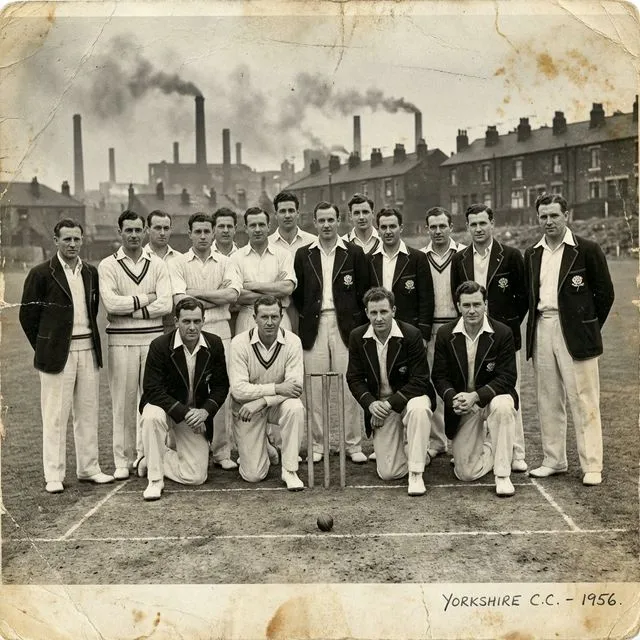
To truly understand the psyche of the club during this pivotal summer, one must look beyond the scoreboards and turn to the visual record. The team photograph of 1956 is far more than a roster of names; it is a sociological document, a static representation of a dynamic and often turbulent internal culture. It serves as a visual audit of an organization in deep transformation. By deconstructing the composition, hierarchy, and attire of the players, we can begin to decode the hidden language of the dressing room.
1.1 The Ghost of the Captain: Sir Leonard Hutton
The most powerful element of the 1956 squad is defined paradoxically by an absence. The context of the season is entirely shaped by the departure of Sir Leonard (Len) Hutton. In January 1956, Hutton, the first professional captain of England in the 20th century, announced his retirement. The decision was forced by deteriorating health and the lingering, debilitating effects of a back injury sustained during the Second World War.
Although Hutton did not play a central role on the field during the 1956 Championship, his presence in the visual memory of the season remained overwhelming. In the press archives of the time, images of Hutton “walking out to bat” were frequently juxtaposed with current team photos, creating the sensation that he was still the spiritual leader of the side. Hutton represented the “Classical Ideal” of the Yorkshire cricketer. His aesthetic was one of immaculate precision: high-waisted white trousers, perfectly pressed shirts, and a blazer worn not as casual sportswear, but with the dignity of a military uniform. His style of play - built on technical perfection, risk aversion, and the careful accumulation of runs - was the benchmark for the “Yorkshire Gentleman,” even though he was a professional by trade. His exit left a vacuum that was felt physically; every batsman in the 1956 lineup was forced to play in the long shadow cast by Hutton, often finding themselves compared to his memory and deemed insufficiently skilled.
1.2 The Rising Rebel: Fred Trueman
Standing in violent contrast to the stoic ghost of Hutton was the figure of Frederick Sewards Trueman. In 1956, Trueman was 25 years old and approaching the zenith of his physical powers. In group photographs, Trueman’s posture often betrayed a brash, restless confidence that differed sharply from the reserved demeanor of his predecessors. Known universally as “Fiery Fred,” he was a fast bowler of genuine hostility and raw speed, a man who played with a fire that bordered on aggression.
If Hutton represented the order of the past, Trueman personified the chaos of the future. He embodied the new energy of the club - raw, sometimes undisciplined, but undeniably brilliant. The relationship between the establishment (personified by Hutton) and the rebellion (personified by Trueman) was complex and fraught with generational tension. Hutton, a man of the old school, had previously been involved in disciplinary measures against Trueman, including the withholding of a tour bonus. The 1956 photograph, therefore, captures the precise moment of friction where the torch was being passed from a disciplined master to a rebellious prodigy, promising a decade of destruction to come.
1.3 The Engine Room: The Supporting Cast
The roster of 1956 reveals a fascinating blend of hardened veterans and future legends, each playing a critical role in the team’s visual and tactical ensemble.
- Bob Appleyard: His serious expression in photographs reflects the gravity with which cricket was played in the North. Appleyard was a bowler of immense skill who had overcome tuberculosis to become the lynchpin of the attack. For him, cricket was a trade to be mastered, not a game to be enjoyed lightly.
- Johnny Wardle: An eccentric but genial left-arm spinner whose casual brilliance was often masked by the uniformity of the team kit. Like Trueman, his relationship with management was complex, but his talent was undeniable.
- Jimmy Binks: The wicket-keeper, the quiet engine of the team. In team photos, the keeper traditionally sat near the captain, symbolizing their tactical intimacy and his role as the “brain” on the field.
- Ray Illingworth: In 1956, he was merely a young all-rounder, yet his youthful face hid a steel-trap cricket mind that would eventually lead him to captain England. Here, he is seen in the chrysalis stage, being forged in the heat of the Yorkshire dressing room.
2. The Semiotics of the White Rose: Clothing as Uniform
The attire captured in the 1956 photograph was not simply sportswear; it was the uniform of a cultural militia. Every thread and stitch carried a symbolic weight understood by every resident of the county.
The Blazer: The Yorkshire blazer was an icon of English sport. In the 1950s, these were typically tailored from heavy wool flannel or gabardine, dyed in a deep midnight blue. The defining feature was the crest on the breast pocket: the White Rose of York. This symbol, tracing its lineage back to the House of York in the Wars of the Roses, was strictly guarded. While other counties might adopt innocuous animals or abstract designs, the White Rose linked the cricket club directly to the feudal history of the region. To wear this blazer was to accept a form of “Northern Chivalry.” In the soot-covered mill towns of Bradford and Leeds, the blazer conferred a social status that mere money could not purchase.
The Cap: The traditional Yorkshire cap, dark blue with the White Rose embroidered on the front, was a badge of honor awarded only after a player received his “capping.” This was a rite of passage marking his acceptance as a senior professional. On the black-and-white film of the era, the sharp contrast of the white embroidery against the dark wool emphasized the exclusivity of this group. It was a visual marker of hierarchy; those who wore it were fully initiated members of the brotherhood.
The Whites: The players wore traditional cream flannel trousers and heavy knit wool sweaters. The aesthetic was one of uniformity and purity, maintaining a visual distinction between the “flannelled fools” on the pitch and the industrial workforce watching from the terraces. The thick cable-knit sweaters were a practical necessity against the biting winds of northern grounds like Bramall Lane, where the chill from the Pennines could cut to the bone even in summer.
3. The “Born in Yorkshire” Doctrine: Pride and Prejudice
If the photograph provided the surface image of the club, the “Born in Yorkshire” rule provided its skeletal structure and ideological foundation. Until 1992, YCCC adhered to a strict policy: only men born within the historic boundaries of the county were eligible to play for the club. This was unique in first-class cricket and defined the club’s ethos for decades.
3.1 The Fortress Mentality
This policy was not merely a recruitment strategy; it was a profound political statement. It asserted that the soil of Yorkshire was so fertile with talent and character that the county could defeat the rest of England - and often the world - without the need for “mercenaries.” Rooted in a deep sense of regional exceptionalism, the rule was originally designed to exclude Lancastrians, reflecting the historic enmity of the Wars of the Roses. It fostered a fiercely loyal dressing room culture where every player shared a common origin, dialect, and understanding of the “Yorkshire Way.” The phrase “Yorkshire born and bred” became a tautology, reinforcing the idea that being a Yorkshireman was a biological imperative, not a geographical accident.
3.2 The Tragedy of Jim Laker
However, while the rule was a source of immense pride, it was also a set of shackles. The rigidity of the policy meant that Yorkshire frequently hemorraged exceptional talent. The most painful example of the 1950s was Jim Laker. Born in Shipley (historically Yorkshire) and educated in Bradford, Laker was a Yorkshireman by blood and birth. Yet, due to administrative rigidity or a lack of early interest from the club, he ended up playing for Surrey - the very team blocking Yorkshire’s path to glory.
In 1956, the very year of this audit, Jim Laker achieved immortality by taking 19 wickets in a single Test match against Australia at Old Trafford. For Yorkshire fans, watching a “lad from Shipley” destroy the Australians while wearing the cap of their southern rivals was a bitter pill to swallow. It highlighted the fundamental flaw in their isolationist philosophy: Yorkshire talent was conquering the world, but not under the banner of the White Rose.
3.3 The Blind Spot of Exclusion
A darker consequence of the rule, which would become increasingly apparent as the 1950s bled into the 60s, was the systemic exclusion of the Asian community. As immigrants from Pakistan and India arrived in Yorkshire to staff the textile mills during the post-war labor shortage, they brought with them a passionate love for cricket. However, because their children were often born abroad, or because the club remained culturally hermetic, this vast reservoir of talent was ignored for decades. The rule, designed to keep out Lancastrians, effectively acted as a “color bar,” alienating the very communities that were revitalizing the region’s economy. In 1956, the team remained exclusively white, a reflection of a definition of “Yorkshireness” that was failing to adapt to the changing face of its own cities.
4. The Industrial Cathedral: Cricket as Social Glue
To understand Yorkshire cricket in 1956, one must immerse oneself in the socio-economic landscape of the West Riding. This was the era of the “Industrial Sublime” - a landscape of smoking chimneys, clattering looms, and rows of red-brick terraced houses.
Cities like Bradford, Leeds, Sheffield, and Halifax were the engine room of the British economy, dominating the textile, steel, and coal industries. Life was hard, physically demanding, and often monotonous. Cricket grounds like Bramall Lane (Sheffield) and Park Avenue (Bradford) were literally embedded in this industrial matrix. Sources describe an atmosphere thick with “ash and dust.” At Bramall Lane, smoke from nearby factories would frequently drift across the pitch, literally and metaphorically darkening the pristine whites of the players. The Yorkshire team weaponized this grimness, cultivating an image of hardy men playing in harsh conditions, in direct opposition to the perceived “softness” of the southern establishment.
For the factory worker or miner, cricket was not just a sport; it was a release. The match provided a space for communal gathering, debate, and the expression of regional identity in a way that work did not allow. The Yorkshire crowd of the 1950s was legendary for its severity. Unlike the polite applause of the southern counties, the Yorkshire spectator was a critic. Known as “barrackers,” they would loudly dismantle any professional deemed “lazy.” This porous border between player and spectator was vital; players like Trueman and Wardle came from the same stock as the men on the terraces. They spoke the same language, shared the same humor, and understood that they were representing the dignity of the working man against the “soft” South.
Underpinning this entire structure was the Bradford League, arguably the toughest club cricket league in the world. It was the forge where players like Hutton and Laker learned their trade. The league was a school of survival, where hardened professionals played alongside ambitious youth in an atmosphere of intense aggression. If you could survive a Saturday afternoon in the Bradford League, you were ready for the County Championship.
5. The Record: A Decade of Struggle and the 1959 Renaissance
While memory often paints Yorkshire as eternally dominant, a detailed analysis of the tables reveals that the 1950s were actually a decade of interrupted dominance and near-misses. The user’s premise of “dominance” is best understood as “competitive relevance,” for in terms of silverware, Yorkshire was the “perennial bridesmaid.”
A reconstruction of the era’s performance shows a team constantly chasing the shadow of Surrey:
- 1952: 2nd Place (Surrey Champions)
- 1954: 2nd Place (Surrey Champions)
- 1955: 2nd Place (Surrey Champions)
- 1956: 4th Place (Surrey Champions)
- 1958: 2nd Place (Surrey Champions)
The 1956 season, finishing in 4th place with 8 wins, was a year of transition. The team was learning to win without its talisman, Len Hutton. The frustration of watching Surrey win seven consecutive titles (1952–1958) created a deep-seated resentment and a desire for revenge within the club.
However, this period of struggle was necessary. The frustrations of the 1950s - the endless second-place finishes, the loss of local talents like Laker - forged a hardened resolve. It took three years after the 1956 transition for the new iteration of the team to fully mature. In 1959, the dam finally broke. Built around the terrifying bowling of Trueman and the batting of young stars like Doug Padgett and Brian Close, Yorkshire finally overthrew Surrey, winning the Championship with 14 victories. This victory was cathartic; it vindicated the “Born in Yorkshire” policy (at least temporarily) and marked the beginning of a new Golden Age that would see Yorkshire dominate the 1960s.
Conclusion
The team photograph of 1956 captures the Yorkshire County Cricket Club in a moment of suspended animation. The great Len Hutton had just walked off the field into history, leaving a void that the explosive, rock-and-roll energy of Fred Trueman was only just beginning to fill. The team stands clad in the heavy wool of tradition, wearing the White Rose that symbolized a policy of fierce, insular pride - a policy that both united the county and blinded it to the changing world outside.
While the record books mark 1956 as yet another year of Surrey dominance, a deeper historical view reveals it as the year Yorkshire gathered its strength. The disappointments of that summer, set against the backdrop of smoking mill chimneys and a changing society, were the fuel for the dynasty that was to come. Thus, the story of 1956 is not one of defeat, but of a giant pausing to reload before the decisive counter-attack.
References & Further Reading
- Wisden Cricketers’ Almanack (Editions 1950–1960)
- Fred Trueman: The Authorized Biography
- The History of Yorkshire County Cricket Club
- Pitched Battles: The History of the Timothy Taylor’s Sutcliffe League
- Anyone But England: Cricket and the Class Struggle