The Spinning Jenny: James Hargreaves's 1764 Invention Explained
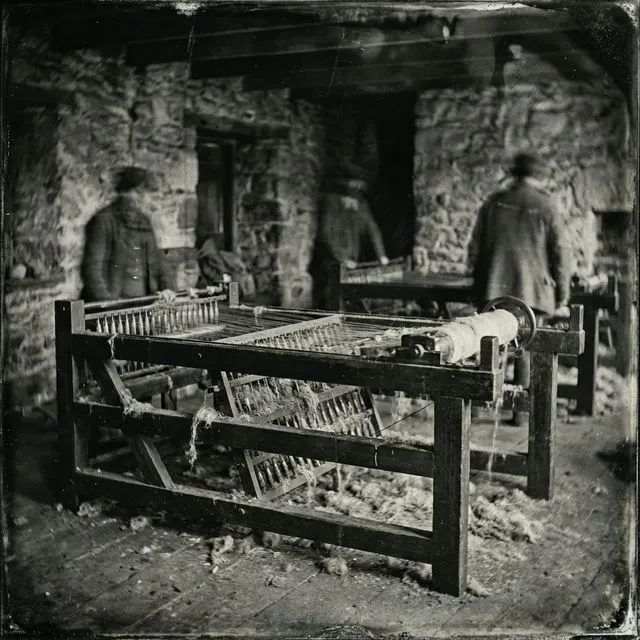
Legend has it that in 1764, a weaver named James Hargreaves in Stanhill, Lancashire, watched his daughter Jenny knock over a spinning wheel. Seeing the spindle continue to revolve upright, an idea struck him: could a single wheel turn multiple spindles at once? The answer – the Spinning Jenny – changed the world.
Whether the story of the fallen wheel is true or embellished, the result was undeniable: a machine that allowed one worker to spin eight threads simultaneously, later scaled to eighty. It broke the fundamental bottleneck of the British textile trade and set the Industrial Revolution in motion.
What Was the Spinning Jenny?
The Spinning Jenny was a multi-spindle spinning frame – a device for converting raw cotton or wool fibres into spun thread. Before its invention, a single spinning wheel produced a single thread. One worker, one spindle, one thread.
Hargreaves’ machine placed multiple spindles side by side, all driven by a single wheel turned by hand. The first version had eight spindles. By the time Hargreaves patented an improved version in 1770, it had sixteen. Commercially produced Jennies built in the 1780s commonly held eighty spindles or more.
The name “Jenny” is most likely a corruption of the word “engine” – a common shortening in Lancashire dialect at the time – though the story of Hargreaves’ daughter remains the more appealing explanation.
How Did the Spinning Jenny Work?
The machine’s mechanism was straightforward but ingenious. The operator sat at one end and turned a large driving wheel by hand. This wheel drove a series of spindles mounted on a horizontal bar, called the spindle rail, via a continuous band of cord or leather.
To spin thread, the worker would:
- Draw out a length of roving (loosely twisted fibre) from a horizontal clamp called the clasp or carriage
- Pull the carriage backward along a sloping rail, stretching and thinning the fibres
- Turn the wheel to set the spindles rotating, which twisted the drawn fibres into thread
- Push the carriage forward again to wind the finished thread onto the spindles
The motion was rhythmic and could be learned quickly. A single experienced worker operating a Jenny could produce as much thread in an hour as eight or ten hand-spinners working at traditional wheels.
Crucially, the Spinning Jenny produced a softer, weaker thread – suitable for the weft (the horizontal threads in weaving) but not strong enough for the warp (the structural threads that ran the length of the loom). This limitation would drive further invention, ultimately leading to Arkwright’s Water Frame and Crompton’s Spinning Mule.
James Hargreaves: Who Was He?
James Hargreaves was born around 1720 in Oswaldtwistle, Lancashire, the son of a hand-loom weaver. He received little formal education and worked most of his adult life as a weaver and carpenter in the village of Stanhill, near Blackburn.
He was, by all accounts, a practical man rather than a scientific one – a craftsman who understood the physical constraints of textile production from daily experience. He had no knowledge of formal mechanics or engineering. His genius was observational: he saw a problem, and he solved it with wood, cord, and ingenuity.
By the early 1760s, Hargreaves had begun experimenting with multi-spindle designs. The exact date of the first working Jenny is disputed – estimates range from 1764 to 1767 – but the machine was demonstrably in use in his household by the mid-1760s.
He was not alone in seeking a solution to the spinning bottleneck. The Society for the Encouragement of Arts, Manufactures and Commerce had offered a prize for an improved spinning machine since 1761. The problem was well-known throughout the trade. Hargreaves simply solved it first.
The Problem the Jenny Solved
To understand what the Spinning Jenny did, you have to start with the problem it solved.
In mid-18th century Britain, the textile trade was booming. The flying shuttle, invented by John Kay in 1733, had dramatically accelerated the speed of weaving. A single weaver with a flying shuttle could now process thread far faster than before – so fast, in fact, that the supply of spun thread could not keep pace.
The numbers were blunt. It took roughly eight hand-spinners working full days to keep one weaver in thread. Weavers sat idle waiting. Merchants couldn’t fill orders. The single-thread wheel was the chokepoint the whole industry was stuck behind.
One Jenny operator could match those eight spinners. An eighty-spindle machine could outproduce sixty of them. The Spinning Jenny didn’t ease the bottleneck – it removed it.
The Riots: Why Spinners Destroyed the Machines
Hargreaves initially kept his invention within his own household, using it to increase his family’s output without public announcement. But word spread, as it always does in a small weaving community.
In 1768, a mob of local spinners broke into his home and destroyed the machines they found there. The violence was not random. It was a calculated act of economic self-defence by workers who correctly understood that the Jenny threatened to make their skills – and their livelihoods – obsolete.
The rioters belonged to a tradition of industrial sabotage that had long roots in English textile communities. Breaking machinery was, for them, a rational response to technological unemployment. The law, at this point, provided them little protection and the new machines less mercy.
Hargreaves was forced to abandon Stanhill. He relocated to Nottingham, where he formed a business partnership with a local businessman named Thomas James, established a small cotton mill, and continued manufacturing and selling Jennies commercially.
He applied for a patent in 1770, but it was challenged and ultimately rendered unenforceable because he had sold machines prior to the application – a technical failure that would cost him significant income. He died in Nottingham in 1778, in modest circumstances, having profited little from the revolution he started.
The Jenny and Its Rivals: A Brief Comparison
The Spinning Jenny did not exist in isolation. It was the first of three interlocking inventions that together mechanised the entire textile production process.
Richard Arkwright’s Water Frame (1769) produced a strong, coarse thread suitable for the warp. Powered by water rather than hand, it was suited to large factory settings rather than domestic use. Where the Jenny extended cottage industry, the Water Frame created the factory system.
Samuel Crompton’s Spinning Mule (1779) combined the principles of both machines. It produced a fine, strong thread that was suitable for both warp and weft, and of a quality that could rival imported Indian muslin. The Mule became the dominant spinning technology of the 19th century and made Lancashire cotton the envy of the world.
The Jenny’s role in this sequence was foundational. It proved the concept of multi-spindle spinning, demonstrated a mass market for improved thread output, and concentrated capital and expertise in Lancashire that drove the subsequent inventions forward. The human cost of that concentration - wages driven to starvation levels, workers dependent on company stores - would eventually produce its own backlash: the Rochdale Pioneers and the cooperative movement of 1844.
Impact on Lancashire and the North
What the Spinning Jenny did to Northern England took less than a generation to play out fully.
Within two decades of Hargreaves’ invention, spinning had migrated almost entirely from cottage to mill. The communities of east Lancashire – Blackburn, Burnley, Rochdale, Bolton – which had been farming and weaving villages became industrial towns at extraordinary speed. Population surged. Streets of back-to-back terraces rose on what had been fields.
The damp climate of the Pennine valleys, long considered a disadvantage, proved ideal for cotton processing: moist air prevented the fine threads from snapping on the machines. The hills provided fast-running streams to power the Water Frames and, later, the coal deposits beneath them fuelled the steam engines that replaced water power.
Lancashire became, within fifty years of Hargreaves’ work in Stanhill, the most productive textile region on earth. By 1850, the county produced more cotton cloth than the rest of the world combined.
This transformation came at enormous human cost. Child labour was endemic in the early mills. Working conditions were dangerous and the hours brutal. The hand-spinners whose livelihoods the Jenny had destroyed found themselves, a generation later, working for wages in the factories that had replaced their cottages. The gains of mechanisation were real – cheaper cloth, higher output, broader trade – but they were distributed with violent inequality.
Key Facts: The Spinning Jenny
- Inventor: James Hargreaves, weaver of Stanhill, Lancashire
- Date of invention: c. 1764–1767
- Patent filed: 1770 (rendered unenforceable)
- Original spindle count: 8
- Later versions: up to 120 spindles
- Thread type produced: soft weft thread (not suitable for warp)
- Hargreaves died: 1778, Nottingham
- Superseded by: Crompton’s Spinning Mule (1779)
Where to See a Spinning Jenny Today
The most significant collection of early textile machinery in Northern England is held at Helmshore Mills Textile Museum in Rossendale, Lancashire – a short drive from Hargreaves’ birthplace in Oswaldtwistle. The museum holds working examples of the Spinning Jenny, the Water Frame, and the Spinning Mule, and offers demonstrations of all three.
The Science Museum in London holds a late 18th-century Jenny in its collections, and the Museum of Science and Industry in Manchester documents the broader transformation of Lancashire’s textile trade in significant depth.
Stanhill itself – now a small village absorbed into the outskirts of Accrington – retains little physical trace of Hargreaves’ presence. A modest memorial marks the approximate site of his cottage. The machine he built there, and the world it unmade, left a larger mark than the man himself ever sought.
References & Further Reading
- Baines, Edward. History of the Cotton Manufacture in Great Britain (1835)
- Fitton, R.S. The Arkwrights: Spinners of Fortune (1989)
- Hills, Richard L. Power in the Industrial Revolution (1970)
- Wadsworth, A.P. and Mann, J. de L. The Cotton Trade and Industrial Lancashire, 1600–1780 (1931)
- Helmshore Mills Textile Museum, Lancashire