The Brontë Sisters: Charlotte, Emily and Anne – Lives, Books and Legacy
In the autumn of 1847, three novels appeared in quick succession from a small London publisher. The authors were listed as Currer Bell, Ellis Bell, and Acton Bell – three brothers, apparently, from somewhere in the north of England. Critics were puzzled. The writing was unlike anything they had seen: raw, morally serious, hostile to the comfortable conventions of mid-Victorian fiction.
Within a year, the secret was out. The Bell brothers were three sisters: Charlotte, Emily, and Anne Brontë, daughters of an Irish clergyman, living in a parsonage on the edge of the Yorkshire Moors. The discovery did nothing to diminish the work. Jane Eyre, Wuthering Heights, and Agnes Grey have remained continuously in print for nearly 180 years.
The Family at Haworth
The story of the Brontës begins with their father. Patrick Brontë was born Patrick Brunty in County Down, Ireland, in 1777, the son of a poor farmer. By sheer force of intellect and determination, he won a place at Cambridge, took holy orders, and eventually settled as perpetual curate at Haworth, a hillside mill town in the West Riding of Yorkshire, in 1820.
His wife, Maria Branwell, died of cancer in 1821, leaving six children under the age of seven. The two eldest daughters, Maria and Elizabeth, were sent to the Clergy Daughters’ School at Cowan Bridge, where conditions were so poor that both contracted tuberculosis and died in 1825. Charlotte, who witnessed their treatment, would later fictionalise the school as Lowood in Jane Eyre. Patrick never remarried. The four surviving children – Charlotte (born 1816), Branwell (1817), Emily (1818), and Anne (1820) – grew up together in the parsonage, educated largely by their father and by themselves.
Childhood: Glass Town, Angria and Gondal
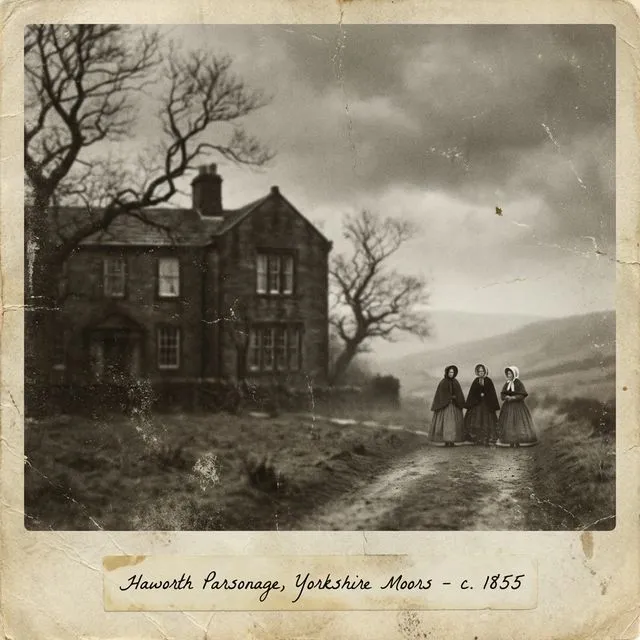
Haworth Parsonage stood directly beside the churchyard, with the moors stretching immediately behind it. The landscape was not picturesque in any conventional sense. It was bleak, wind-scoured, and intimate with death – the water supply ran through the graveyard, and mortality rates in Haworth were appalling even by Victorian standards.
In this setting, the children created something extraordinary. Inspired by a set of toy soldiers Patrick brought home for Branwell, they invented elaborate imaginary worlds. Charlotte and Branwell built Glass Town, a vast African empire loosely based on Wellington’s campaigns, which they later developed into the kingdom of Angria. Emily and Anne, who collaborated independently, created Gondal: a northern island nation whose romantic and violent history they chronicled in hundreds of poems and prose narratives, most of which are now lost.
These childhood writings – produced in tiny hand-stitched booklets with minuscule print, as if designed to be read only by themselves – were not mere play. They were a sustained literary apprenticeship. Charlotte and Branwell’s Angrian tales ran to hundreds of thousands of words; Emily’s Gondal poems, which survived, are some of the finest lyrics she wrote.
The Struggle to Write and Work
None of the Brontë sisters could live by writing alone – at least not yet. Victorian women of limited means had few options for earning a living, and the Brontës spent years trying and largely failing to make careers as teachers and governesses.
Charlotte, Emily, and Anne all worked as governesses at various points. The experience was miserable. Governesses occupied an awkward social position: too educated for the servants, too employed for the family. Anne’s novel Agnes Grey (1847) is a direct account of the degradations of the role.
In 1842, Charlotte and Emily travelled to Brussels to study French and German at the Pensionnat Héger, hoping to improve their qualifications to open a school. Charlotte fell deeply in love with her teacher, Constantin Héger, a married man who eventually stopped writing to her. The experience devastated her and animated some of her most powerful fiction: the Belgian sections of Villette (1853) and the tormented relationship at the heart of The Professor draw directly from it.
The plan to open a school at Haworth never materialised – no pupils came.
The Pseudonyms: Currer, Ellis and Acton Bell
By the mid-1840s, writing had moved from fantasy to serious literary ambition. Charlotte discovered Emily’s private notebook of poems in 1845 – possibly by accident, certainly without permission. Emily was furious, but Charlotte persuaded her that the poems were too good to remain private.
The three sisters pooled their work and published Poems by Currer, Ellis and Acton Bell in 1846 at their own expense. It sold two copies. The choice of pseudonyms was deliberate: they wanted names that were ambiguous enough to conceal their sex without being outright deceptions. “We had a vague impression,” Charlotte later wrote, “that authoresses are liable to be looked on with prejudice; we had noticed how critics sometimes use for their chastisement the weapon of personality, and for their reward a flattery, which is not true praise.”
The novels came next. Charlotte’s The Professor was rejected by every publisher who saw it. Emily and Anne’s joint submission – Wuthering Heights and Agnes Grey – found a taker in Thomas Newby of London. Charlotte, undeterred, wrote Jane Eyre and sent it directly to Smith, Elder & Co. It was accepted, revised, and published in October 1847. Wuthering Heights and Agnes Grey appeared in December.
Charlotte Brontë and Jane Eyre
Jane Eyre was a phenomenon. It sold out its first edition within weeks and generated fierce debate about its morality – many readers were disturbed by its plain-spoken heroine, its attack on religious hypocrisy in the figure of Mr Brocklehurst, and the suggestion that a woman might legitimately refuse a man on moral grounds.
The novel follows Jane Eyre from childhood misery at Gateshead Hall and the Lowood School through her employment as a governess at Thornfield Hall and her relationship with its owner, Edward Rochester. The revelation of Rochester’s secret marriage to Bertha Mason, the fire, Jane’s flight, and the eventual resolution on terms that preserve her moral integrity rather than simply delivering her into happiness – the novel’s shape was unlike anything that had come before it.
Charlotte wrote two further novels of considerable power: Shirley (1849), set during the Luddite disturbances in Yorkshire, and Villette (1853), her darkest and most autobiographical work, drawn from the Brussels years.
Emily Brontë and Wuthering Heights
Emily’s single published novel remains one of the most debated works in English literature. Critics in 1847 called it savage, coarse, and unpleasant. They were largely right about its savagery. Wuthering Heights is a novel about obsession, cruelty, class, and revenge, narrated through multiple unreliable voices and structured around two generations of damage.
At its centre is Heathcliff – a foundling of unknown origins brought to the Heights by old Mr Earnshaw, who grows into something that defies easy categorisation as hero or villain. His relationship with Catherine Earnshaw is not a love story in any comfortable sense. It is an account of two people so alike in nature that their connection destroys everyone around them, and eventually themselves.
Emily Brontë wrote very little else that survives in published form. Her poems – several of which she produced for the Gondal cycle – are among the finest of the Victorian period. “No coward soul is mine,” written in 1846, is often read at funerals and remains the best-known.
She was, by all accounts, a profoundly private person. Patrick Brontë described her as stronger-minded than most men. She refused, when ill, to see a doctor until it was too late.
Anne Brontë: The Overlooked Sister
Anne is the Brontë most often crowded out by her sisters’ reputations. This is unjust.
Agnes Grey (1847) is a slim, precise novel of a governess’s working life, written with a clarity and moral directness that owes nothing to melodrama. The Tenant of Wildfell Hall (1848) is a more ambitious work – the story of Helen Graham, a woman who has fled her abusive, alcoholic husband and is trying to support herself and her son. It was the first English novel to deal seriously with domestic abuse and alcoholism, and Charlotte, after Anne’s death, refused to authorise its republication – apparently finding its subject matter embarrassing.
Anne’s reputation has recovered significantly in recent decades. Many modern readers find Wildfell Hall more honest and structurally sophisticated than anything her sisters produced.
Branwell, and the Collapse
While the sisters were writing their novels, their brother Branwell was destroying himself.
He had been the most celebrated of the children as a young man – talented, charming, apparently destined for great things as a painter or poet. He failed to gain entry to the Royal Academy, worked as a railway clerk until dismissed, worked as a tutor until dismissed (for reasons that were whispered to involve an affair with his employer’s wife), returned to Haworth, and spent the last years of his life in a spiral of opium addiction, debt, and alcohol.
He died in September 1848, aged 31. Emily died of tuberculosis in December 1848, three months after her brother, having refused to see a doctor or change her routines in any way. Anne died at Scarborough in May 1849, 29 years old, having travelled to the seaside in a last attempt to recover.
Charlotte, the eldest surviving child, was left alone with her ageing father.
Charlotte’s Last Years
Charlotte published Shirley in October 1849, weeks after Anne’s death. She went on to write Villette and to meet, at her publisher’s offices in London, many of the leading literary figures of the age – Thackeray, whom she idolised and who embarrassed her by introducing her to a dinner party as “Jane Eyre”; Elizabeth Gaskell, who would later write her biography.
In 1854, she married her father’s curate, Arthur Bell Nicholls, against Patrick’s initial objections. She was 37. She died in March 1855, almost certainly from hyperemesis gravidarum – severe pregnancy sickness – at 38 years old. She had been married nine months.
The Legacy
Elizabeth Gaskell’s Life of Charlotte Brontë (1857), published two years after Charlotte’s death, fixed the Brontë myth in the public imagination: the isolated parsonage, the windswept moors, the doomed family. The biography emphasised the harshness of their circumstances partly to deflect criticism of Charlotte’s novels; some of it overstated the isolation and grimness.
The reality is more interesting than the myth. These were not passive victims of circumstance. They were women of fierce ambition and intellectual seriousness who read voraciously, thought independently, and produced, in a period of roughly three years, a body of work that permanently changed English fiction.
The Brontë Parsonage Museum at Haworth opened in 1928 and remains one of the most visited literary museums in Britain. Charlotte’s writing desk, Emily’s narrow bed, the dining room table where they wrote in the evenings after their father went to bed – the parsonage survives largely intact, a physical archive of where the work was done.
Visiting Haworth Today
Haworth is a village in the Keighley area of West Yorkshire, approximately 8 miles west of Bradford and 10 miles north-west of Halifax. It is easily reached by rail: the Keighley and Worth Valley Railway, a preserved steam railway, runs from Keighley through Haworth to Oxenhope.
The Brontë Parsonage Museum is open year-round (closed January). The collection includes manuscripts, letters, Charlotte’s portable writing desk, Patrick Brontë’s spectacles, and the small watercolour portrait of Emily painted by Branwell – the only authenticated image of her that survives.
The moors above Haworth are the setting for the Brontës’ walks and for the landscape of Wuthering Heights. The farmhouse at Top Withens, now a ruin, is traditionally identified as the model for the Heights; it lies about 3 miles from the parsonage across open moorland.
Anne Brontë is buried at St Mary’s Church, Scarborough, where she died – the only Brontë not interred at Haworth.
Key Facts
- Charlotte Brontë: born 1816, died 1855. Jane Eyre (1847), Shirley (1849), Villette (1853)
- Emily Brontë: born 1818, died December 1848. Wuthering Heights (1847)
- Anne Brontë: born 1820, died May 1849. Agnes Grey (1847), The Tenant of Wildfell Hall (1848)
- Pseudonyms: Currer Bell (Charlotte), Ellis Bell (Emily), Acton Bell (Anne)
- Location: Haworth Parsonage, West Yorkshire
References & Further Reading
- Gaskell, Elizabeth. The Life of Charlotte Brontë (1857)
- Gordon, Lyndall. Charlotte Brontë: A Passionate Life (1994)
- Barker, Juliet. The Brontës (1994) – the definitive modern biography
- Brontë Parsonage Museum, Haworth: bronte.org.uk